
Take everything out. Yes, everything.
Working around what is already hanging is the single most common mistake. You end up reorganising the same arrangement you already had, and the closet looks tidier for a fortnight before it reverts.
Pull every item onto the bed. The bed matters: it forces you to finish, because you have to sleep there. Give yourself three hours for a reach-in and most of a day for a walk-in.
Sort into four piles, not two
Keep and donate is too blunt a choice, and it is why people stall. Use four piles: keep, donate, repair, and undecided.
The repair pile is the one that frees up the most space. Most people are storing three or four items they would wear tomorrow if a button were sewn on. Either book the repair this week or let it go — a repair pile that lives for six months is a donate pile that has not admitted it.
Try on everything in the undecided pile
This is the part people skip, and it is the part that works. Guessing from the hanger is how clothes you have not worn in three years stay in rotation for another three.
Put it on. If you would not leave the house in it today, it goes. The question is not whether it fits or whether it was expensive — it is whether you will wear it.
Hang by category, then by colour
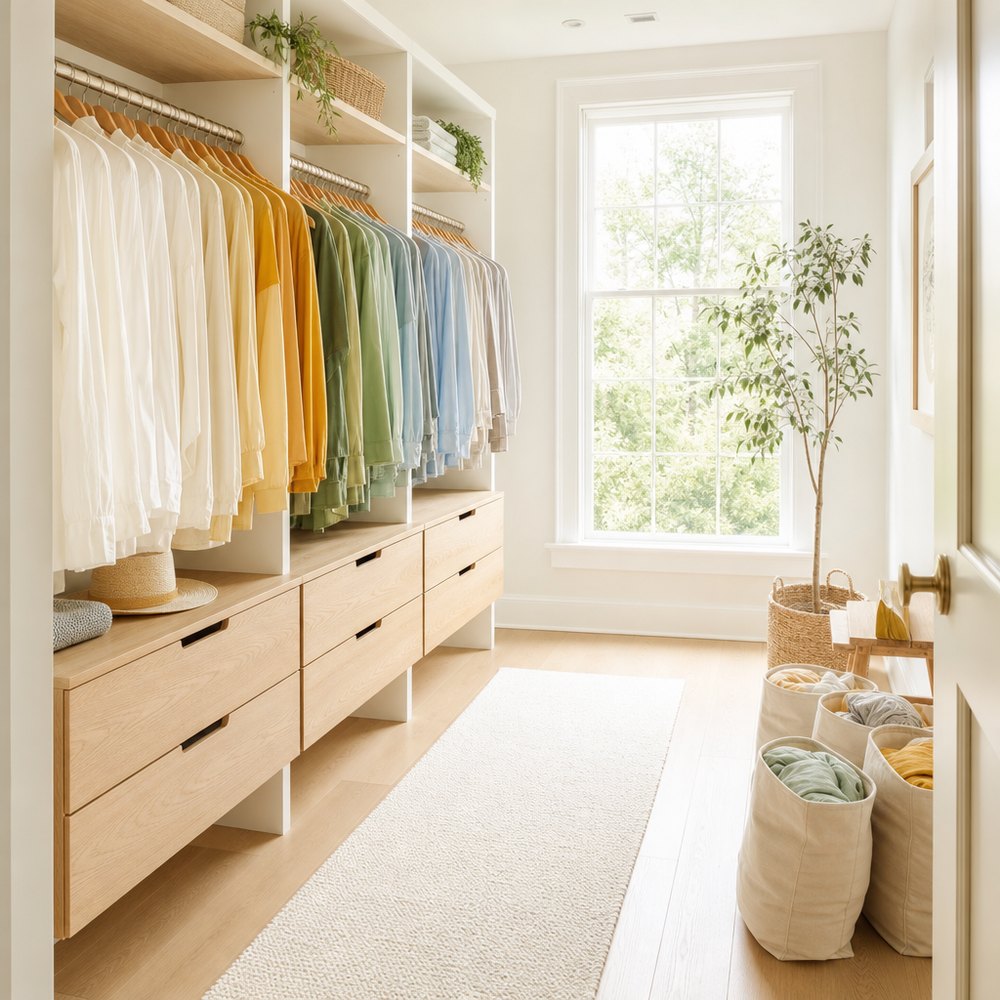
Category first: shirts with shirts, trousers with trousers, dresses with dresses. Then order each category light to dark. It sounds fussy and it takes ten extra minutes, but it is the reason an organized closet stays organized — a misplaced item is visually obvious, so it gets put back.
Keep every hanger the same. Matching hangers are not an aesthetic affectation: uniform hanger depth is what lets you see the shoulder line of every garment at once, which is the whole point.
Fold what hanging ruins
Knitwear, heavy jumpers and most denim should be folded. Hanging stretches the shoulders of anything knitted, and you will lose the garment faster than you will wear it out.
Fold to one depth so the stack does not topple, and stack no more than five high. Above five, you stop lifting the top items off to reach the bottom and start pulling from the middle.
Give the floor back
Shoes on the floor are the fastest way to make a closet feel chaotic. Get them onto a rack, a shelf, or into clear boxes — anywhere the floor reads as empty.
An empty closet floor does more for how organized a closet feels than any container you can buy.
Zone the rail by how often you reach for it
Within each category, put the things you wear weekly at the centre of the rail, where your hand naturally lands. Occasion wear goes to the far ends.
This is the difference between a closet that is organized and a closet that is fast. You should be able to dress without scanning, and that only happens when frequency, not just category, has shaped the layout.
Use the shelf above properly
The top shelf is where most closets go wrong. It becomes a dumping ground because nothing up there has a defined home, and because you cannot see it from standing height.
Put it to work for one thing only: off-season storage, in labelled boxes of a uniform size. Uniform boxes matter more up high than anywhere else, because you are reading the labels from below at an angle, not browsing the contents.
Handle the things that are not clothes
Bags, belts, scarves and hats are what break an otherwise good closet, because they have no natural shape and no obvious home. Left loose they migrate onto the rail and the floor.
Bags stand upright on a shelf with dividers between them, or they collapse into each other and crease. Belts and scarves go on hooks on the door, not coiled in a drawer where you cannot see which is which.
What to do with the donate pile
Get it out of the house the same day. A donation bag that sits in the hall for three weeks gets unpacked, usually one garment at a time, and by the end of the month the edit has quietly reversed.
If some of it has real resale value, bag that separately and set one deadline. Consignment that has not left in a month is donation that has not admitted it.
The five-minute weekly reset
No system survives without maintenance, but good systems need very little. Once a week, rehang anything draped over a chair, return strays to their category, and put the laundry away in order rather than in a heap.
Five minutes, once a week. That is the whole maintenance cost of a closet that was set up properly.