
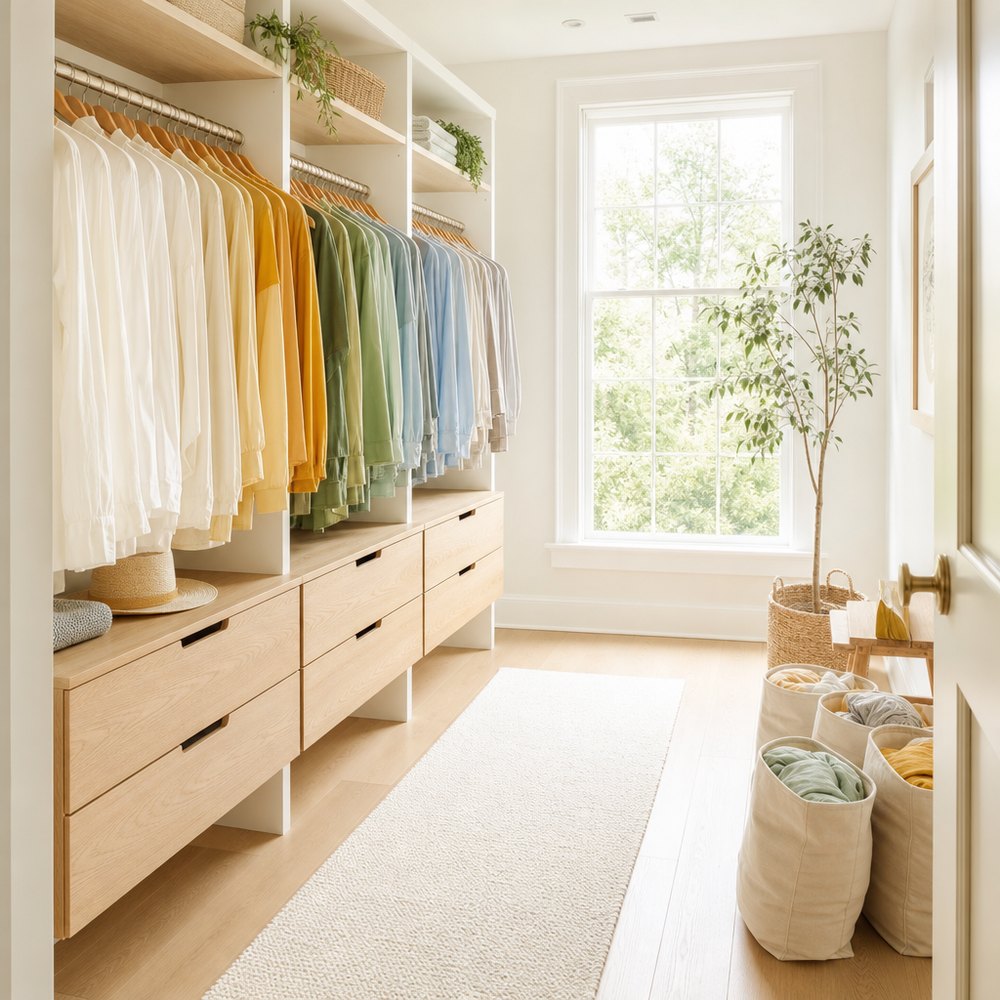
Use the height, not the floor
Almost every small closet has eighteen inches of dead air above the top shelf and another twelve below the hanging rail. That is where the capacity is.
A second rail under the shirts roughly doubles hanging space for anything short — shirts, skirts, folded trousers. It is the single highest-return change you can make to a small closet, and it costs very little.
Only one season lives in the closet
A small closet cannot hold a full year of clothing and stay usable. Off-season goes elsewhere: under the bed, the top shelf, a different room.
This alone typically frees up a third of the rail, and it costs you two changeovers a year.
Be honest about the numbers
Small closets punish duplicates harder than large ones. Nine black t-shirts in a big closet is clutter; in a small closet it is the reason nothing fits.
Pick the best three of anything you own more than five of. You will not miss the rest, and you will be able to see what you kept.
Slim hangers, every one the same
Velvet or slim hangers recover a surprising amount of rail — usually several inches across a full closet, which is a few more garments you can actually see.
More importantly, uniform hangers keep the shoulder line even, and an even shoulder line is what makes a packed rail readable rather than overwhelming.
Put the door to work
The back of the door is the most underused surface in a small closet. Shoes, bags, belts and scarves all live happily there and come off the rail and floor.
Keep the floor clear. In a small space especially, a visible floor is what stops the closet reading as stuffed.